UK ASA Ruling on Lab Grown Diamond Advertising: Definition Battle Behind the Verdict

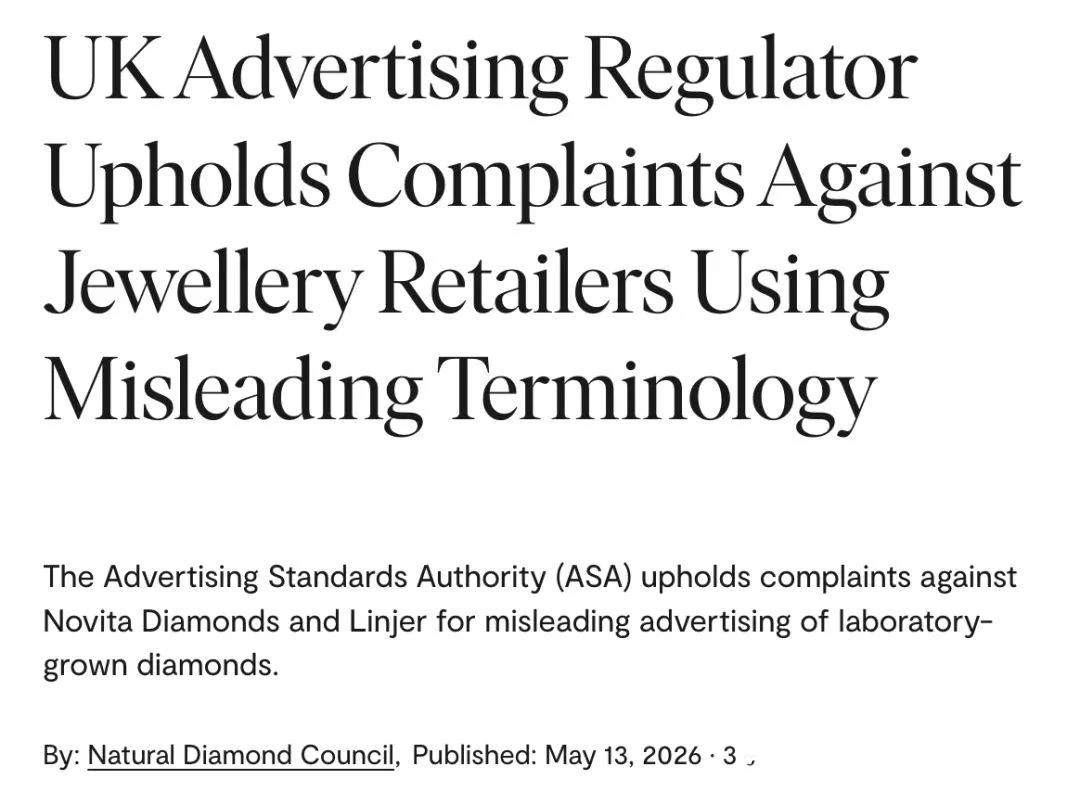
On May 13, the UK Advertising Standards Authority (ASA) issued a ruling that could reshape the jewellery industry: two online retailers selling lab grown diamonds were ordered to remove or revise their ads for using the term “diamond” in promotions.
Looking beyond the surface, the real protagonist of this ruling is not consumers at all.

The Battle Over Definition Rights
Linjer Jewelers, a Hong Kong-based online jewellery retailer, ran two Google paid ads in January this year featuring the phrase “Discover our brilliant diamonds”. One ad showed a diamond ring, while the other claimed the products used “ethically sourced gemstones”.
The catch? They sold lab grown diamonds.
Linjer argued that “brilliant” described the cutting technique, and ordinary consumers would understand it referred to the cut style. But the ASA’s response was straightforward: average consumers would not think that way—they would assume “brilliant diamonds” meant natural diamonds. Whether a diamond is natural or lab grown is critical information for purchase decisions and must be clearly disclosed upfront.
The ASA ruled the ads violated the CAP Code (UK Non-Broadcast Advertising Rules) regarding misleading advertising and qualifying terms. It explicitly ordered Linjer not to use “diamond” alone to refer to lab grown diamonds and prohibited the ads from reappearing in their original form.

An even more notable case involves Novita Diamonds, an Australian-based lab grown diamond retailer. It faced complaints over two Meta ads: one showing an engagement ring with the text “Novita Diamonds Ready-to-Ship Engagement Rings 1-10 days”; the other a video ad displaying the ring from multiple angles, captioned “Premium Diamonds” and “Shop our ready-to-ship collection today – Novita Diamonds”.
Neither ad included qualifiers like “lab” or “synthetic”. The ASA deemed them misleading and banned the original versions.
Novita put forward three strong counterarguments that cut to the core of the debate:
- The ads never claimed the diamonds were natural, rare or mined.
- Scientifically, lab grown diamonds fully meet the definition of diamonds—same chemical composition, crystal structure, physical and optical properties. The production method only differs in manufacturing process, not the material itself.
- Current UK laws do not restrict the term “diamond” to geologically formed stones.
These arguments were compelling, shifting the debate from ethics to definition: why deny a material scientifically identical to diamond the right to be called a diamond?
However, the ASA took a narrow stance: while physical and chemical properties match, lab grown diamonds differ in “future value”. In short, natural diamonds hold greater long-term worth. This logic remains highly questionable.
The Rule-Makers Behind the Complaints
To truly understand this ruling, we must identify the complainants: the Natural Diamond Council (NDC) and the London Diamond Bourse (LDB), both representatives of the natural diamond mining industry.
After the ruling, NDC CEO Amber Pepper called it a “victory for consumers”. She added: “Diamonds carry deep emotional meaning, marking life’s key moments. Consumers must choose with full information.”
“This is not our first successful challenge to ads blurring the line between factory-made products and nature’s billion-year-old creations,” she said.
LDB Chairman David Troostwyk stated the ruling sent a “strong message” that misleading ads would not be tolerated.
The phrase “victory for consumers” is subtly misleading.
Lab grown diamonds gain popularity for lower prices, equal quality and ethical production (no mining). Phrases like “ethically sourced gemstones” highlight this ethical edge for many buyers.
For the natural diamond industry, however, this phrase is a double insult: it implies natural diamonds are unethical while framing lab grown diamonds as an ethical choice.

A Carefully Crafted Perception War
Viewed in a broader context, a clear strategy emerges.
Lab grown diamonds cost far less than natural diamonds, with mass production driving prices down. Their U.S. retail market share surged from 3% in 2020 to around 17% (data unconfirmed), alarming the natural diamond industry.
Unable to compete on price, the battle shifted to rule-making.
The term “diamond” became the core battleground. If lab grown diamonds must always carry qualifiers like “lab-grown”, “synthetic” or “laboratory-created” in ads, while natural diamonds use “diamond” alone, an imbalance arises. Natural diamonds become the “default”, and lab grown diamonds the “exception”. Over time, consumers will view “real diamonds” as natural ones, with lab-grown versions as mere substitutes.
This uses linguistic rules to uphold the narrative that “natural is superior to artificial”. Following the lab grown diamond advertising regulation UK ASA, Novita revised its ads by adding “lab” before “diamonds” but stated it did not believe the original ads were misleading—complying with rules while reserving the right to challenge them.

One Diamond, Two Narratives
This fight over the definition of “diamond” reflects a broader modern question: when technology perfectly replicates nature and erases differences, how do we define “authenticity”?
For the natural diamond industry, “authenticity” ties to geological origin, billion-year formation and rarity—the foundation of its pricing power.
For the lab grown diamond industry, “authenticity” depends solely on the diamond’s properties: chemical composition, hardness, refractive index. How and where it is made does not diminish its intrinsic value as a diamond.
Both narratives hold logic, but the ruling sided with one. While legally sound, the lab grown diamond advertising regulation UK ASA ruling raises a question: who truly benefits from this naming war—consumers, or industries fearing obsolescence?
In an era of fast information and rational consumption, consumers deserve transparency that lets choices focus on the product itself. This is exactly what the lab grown diamond advertising regulation UK ASA ruling fails to address.