Is a Lab-Grown Diamond Ring Right for an Engagement? HPHT vs CVD Explained
Quick Summary
Core Reality: Lab-grown diamonds share identical physical, chemical, and optical properties with natural diamonds; they are 100% real diamonds, not simulants like moissanite.Tech Breakdown: HPHT (High Pressure High Temperature) dominates under 2 carats with high color; CVD (Chemical Vapor Deposition) produces larger stones over 2 carats with superior clarity.
Buying Strategy: IGI certification is the industry standard for lab diamonds. Opting for a D/E color, VS1 clarity, and 3EX cut offers peak visual performance while saving up to 70-80% compared to mined gems, making it the smartest choice for modern custom engagement rings.
Table of Contents
Lab-grown diamonds (also known as synthetic or cultured diamonds) share identical physical and chemical properties with natural mined diamonds. To the naked eye, there is absolutely zero visual difference. The distinctions only exist at a microscopic level and require professional gemological laboratory equipment to detect. For instance:
- DiamondView (Growth Pattern Analytics): Natural diamonds exhibit irregular, organic growth lines, whereas lab-created stones show highly regulated, square-like growth patterns due to their controlled environment.
- UV-Visible Spectrophotometer: Approximately 98% of natural diamonds contain trace amounts of nitrogen (Type Ia), which display specific absorption peaks under certain wavelengths. Conversely, lab diamonds are essentially nitrogen-free, showing no such absorption peaks.
Thanks to the rapid maturation of lab diamond synthesis, traditional diamond simulants like moissanite vs lab diamond options or Cubic Zirconia (CZ) have been completely outclassed. While simulants only mimic the look of a diamond, a lab diamond delivers the exact optical performance of a natural stone, making it the ultimate high-value alternative.
HPHT vs CVD Diamond Manufacturing: Understanding the Tech
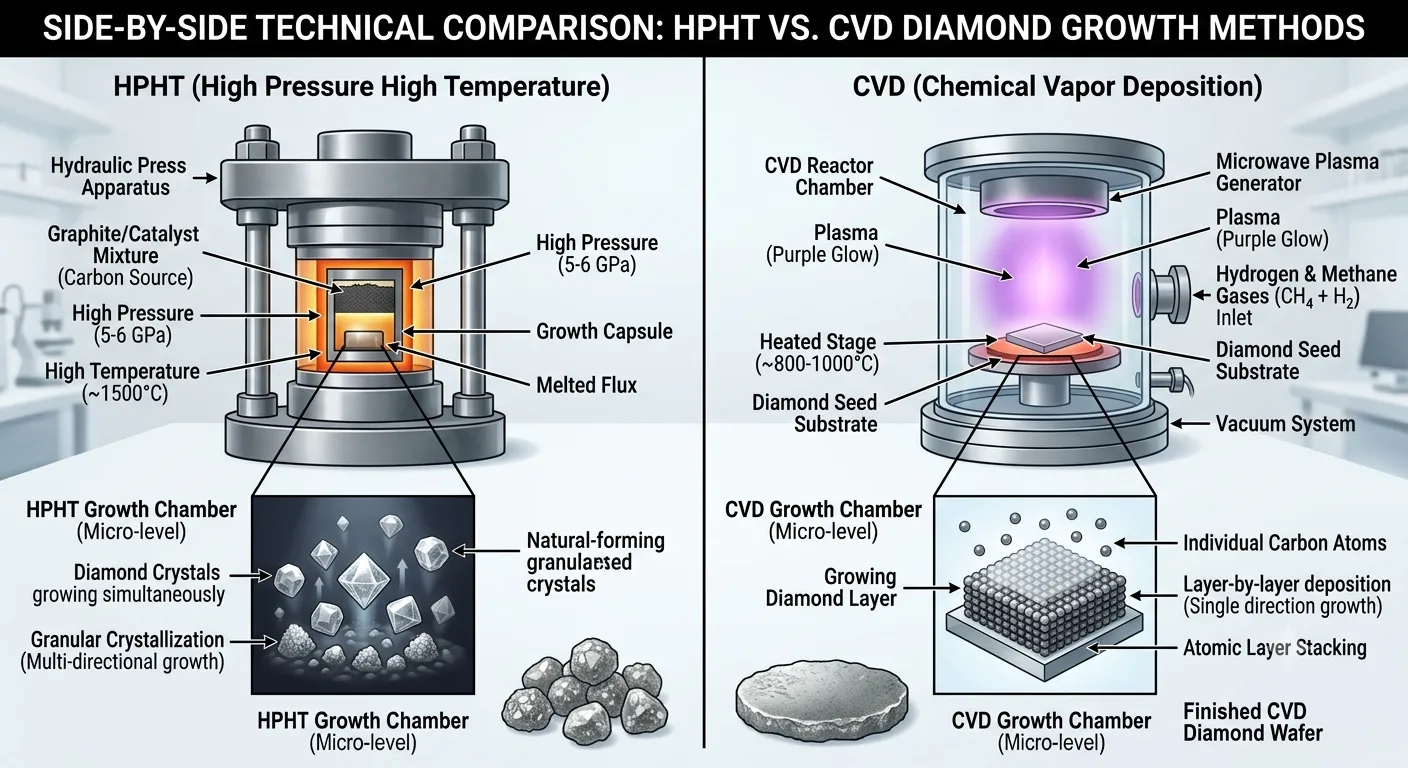
To create these stones, laboratory equipment replicates the extreme conditions found deep within the Earth, crystallizing carbon atoms into a diamond lattice structure within a few weeks—a process that takes nature billions of years. The industry relies on two primary manufacturing methods:
High Pressure High Temperature (HPHT)
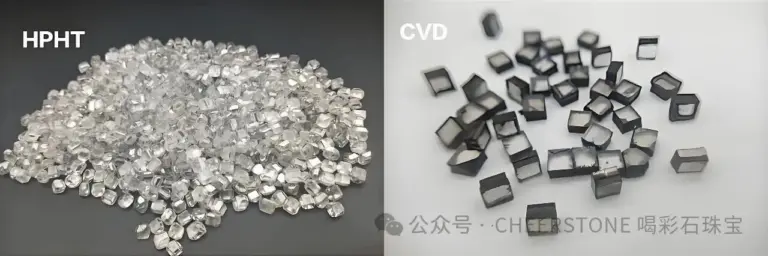
The HPHT method produces a granular growth structure and is primarily utilized for growing diamonds under 2 carats. HPHT diamonds typically achieve excellent color grades right out of the machine, though their clarity might require stricter sorting due to occasional microscopic metallic inclusions.
Chemical Vapor Deposition (CVD)
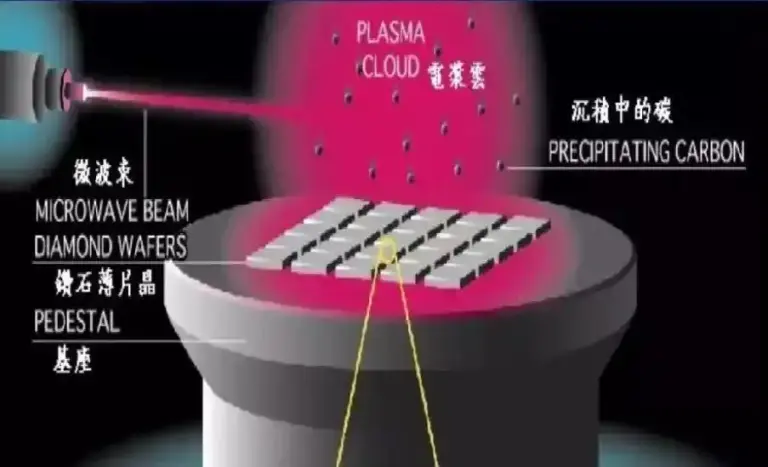
The CVD method introduces isolated carbon atoms into a vacuum chamber, allowing them to deposit and stack layer-by-layer onto a diamond seed plate. This creates a tabular, flat growth structure ideal for producing larger diamonds over 2 carats. While CVD diamonds yield exceptional clarity, their color can be unpredictable, often requiring post-growth high-temperature heat treatment to optimize their color grade.
There is no absolute “better” or “worse” method between the two; each has its unique production advantages, and their wholesale market prices remain virtually identical for matching grades. When sourcing a lab-grown diamond ring for engagement, you do not need to stress over the growth method. Any marketing claiming one method is inherently superior to the other is simply inaccurate. Trust the independent grading on the certificate instead.
Lab-Grown Diamond 4Cs Grading Standard
Lab diamonds do not use a separate grading scale; they are evaluated using the exact same “4Cs” framework established for natural diamonds:
- Carat Weight: One carat equals 0.2 grams or 100 points. Diamonds under 1 carat are usually referred to by points (e.g., a 50-point diamond is 0.50 carats). The commercial market primarily focuses on 0.50-carat to 2-carat sizes, while micro-diamonds (melee) are less common in the lab sector.
- Color Grade: Ranging from D (completely colorless) down to Z (light yellow/brown). Because modern synthesis is highly advanced, the majority of lab diamonds hit the premium D to F colorless range. Low-color rough is typically filtered out at the factory source.
- Clarity Grade: Spanning 11 levels from FL (Flawless) to I3 (Included). Most lab-grown inventory sits securely at the VS level or higher. Low-clarity rough is rarely selected for gem-cutting.
- Cut Grade: Round brilliant diamonds are scored on proportions, polish, and symmetry from EX (Excellent) down to P (Poor). A stone scoring Excellent across all three is called a “3EX Cut,” which maximizes light refraction for that iconic fire and brilliance. Since cutters don’t need to preserve raw weight aggressively as they do with expensive mined rough, almost all lab diamonds are cut to 3EX standards.
- Fluorescence: This measures a diamond’s reaction under UV light, ranging from None (N) to Very Strong (VS). Fluorescence has a negligible impact on daily wear, but selecting “None” is generally recommended for absolute purity.
Custom Buying Recommendation
Because the baseline quality of lab-grown inventory is exceptionally high, you don’t need to spend hours filtering out low-grade defects. Targeting a D or E color, VS1 clarity, 3EX cut, and None fluorescence will land you a visually flawless, top-tier diamond.
Demystifying Independent Lab Certifications (IGI vs GIA)
The premier certification for lab diamonds is issued by the International Gemological Institute (IGI). IGI certificates offer international recognition, highly accurate grading, and accessible pricing that aligns perfectly with the value proposition of lab stones. IGI operates major labs in Shanghai and India under a single, unified grading standard, so the lab location does not affect the stone’s grade.
While the Gemological Institute of America (GIA) also grades lab-grown stones, their steep testing fees drive up costs unnecessarily, which conflicts with the budget-friendly appeal of lab diamonds. Consequently, they are less frequently utilized in the upstream market.
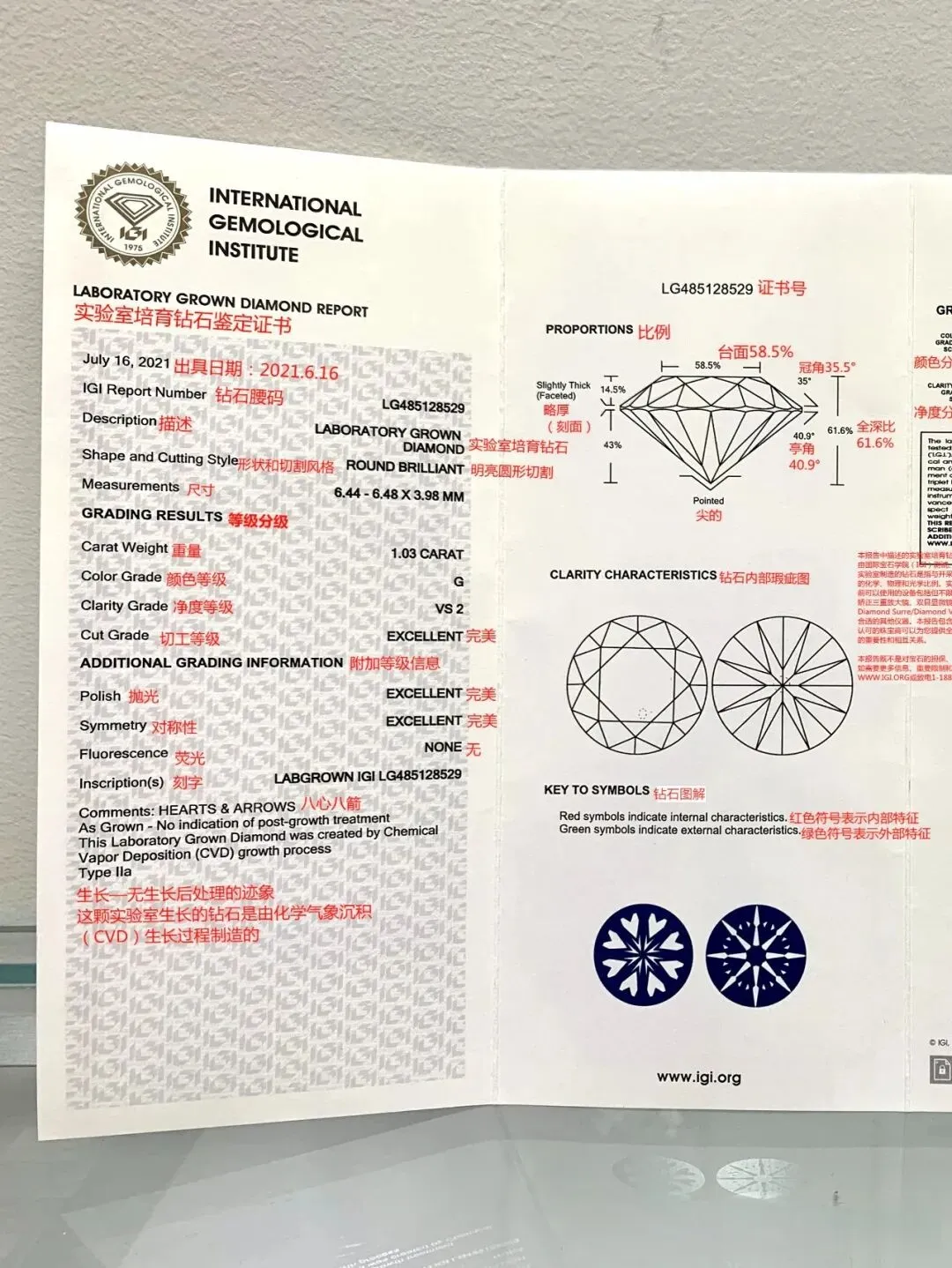
For domestic Chinese verification, the National Gemstone Testing Center (NGTC) enforces incredibly strict standards, but they primarily certify fully set finished jewelry rather than loose stones. Ultimately, an IGI certificate is more than sufficient to verify your purchase confidently.
Wholesale Lab-Grown Diamond Price Comparison & Budgeting
Lab-grown diamonds offer massive cost savings over their mined counterparts. Below is a realistic budget breakdown for customizing a complete ring set with an 18K gold setting (assuming a standard custom setting cost of approximately $300 to $400):
| Diamond Size | Custom Lab Diamond Ring Budget | Mined Diamond Equivalent Cost |
| 0.50 Carat | ~$700+ | ~$2,000+ |
| 0.70 Carat | ~$850+ | ~$2,800+ |
| 1.00 Carat | ~$1,000+ | ~$5,500 – $8,500 |
| 1.50 Carat | ~$1,250+ | ~$12,500 – $20,000 |
| 2.00 Carat | ~$1,700+ | ~$20,000 – $35,000 |
To put this in perspective: with a modest budget of around $850, shopping for a natural diamond limits you to a modest 30-point stone. Shifting that same budget to a lab-grown alternative allows you to comfortably secure a full 1.00-carat ring. The financial leverage to “buy a bigger diamond for less money” is undeniable.
Strategic Sourcing and Modern Engagement Trends
Major luxury retail brands have largely avoided lab-grown collections to protect their legacy mined diamond margins. As a result, this product category is heavily concentrated among agile independent custom jewelers and direct upstream wholesalers. This keeps brand markups incredibly low, anchoring the retail price close to the actual raw material cost. To maximize your value, sourcing directly from global jewelry supply hubs (such as the Shenzhen Shuibei jewelry market) is highly effective.
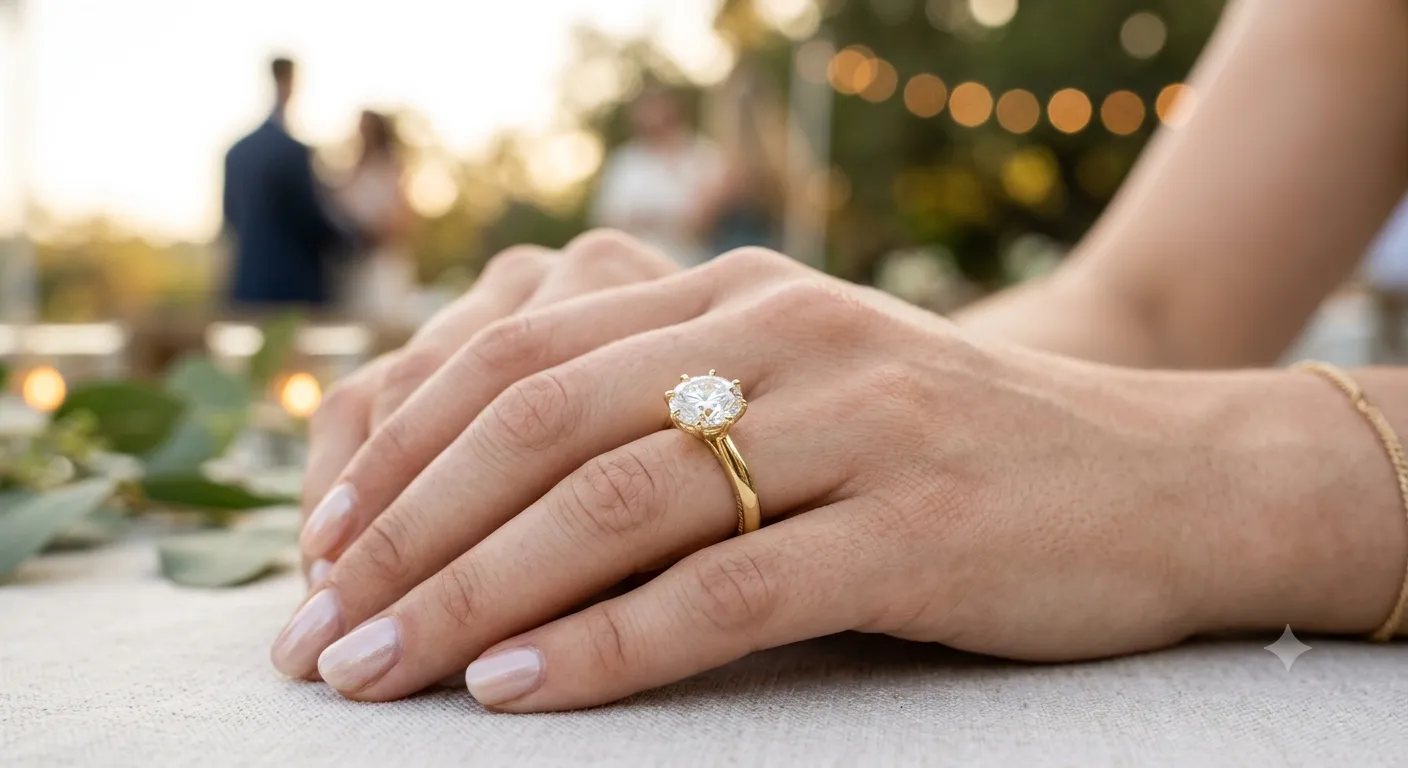
When it comes to modern marriage proposals, a lab-grown diamond ring right for engagement is a completely valid, smart, and deeply practical choice. It offers pristine visual beauty without the crippling financial stress, which appeals heavily to couples prioritizing smart asset allocation. The thousands of dollars saved on the center stone can be reallocated toward appreciating assets like pure gold jewelry, a down payment, or a honeymoon—aligning perfectly with the conscious consumption values of the new generation.
Frequently Asked Questions About Lab-Grown Diamonds
Will a lab-grown diamond pass a diamond tester?
Yes. Standard thermal conductivity testers (the most common type used by jewelers) cannot tell the difference because lab-grown diamonds share the exact same thermal properties as natural diamonds. Only advanced spectroscopic machines like DiamondView can distinguish them.
Do lab-grown diamonds get cloudy over time?
No. Unlike Cubic Zirconia (CZ) or some simulants, lab-grown diamonds are chemically stable and rank 10 on the Mohs scale of hardness. They will not cloud, fade, or lose their brilliance over time unless physically damaged.
Should I choose HPHT or CVD for my engagement ring?
For most buyers, the growth method (HPHT vs CVD) is less important than the final 4Cs grade on the certificate. However, if you are looking for a stone under 2 carats, HPHT often yields better color. If you want a stone over 2 carats, CVD typically offers superior clarity. Always prioritize the IGI certificate specs over the growth method.
Do lab-grown diamonds hold their resale value?
Currently, lab-grown diamonds have a different resale market compared to natural diamonds. While natural diamonds retain significant value due to rarity, lab-grown prices are driven by technology and manufacturing efficiency. The primary value of a lab-grown engagement ring lies in the emotional significance and the massive upfront savings compared to mining.